How it works
From one conversation to work that runs on its own.
Three steps. The first two are free, and nothing is owed on either side until you decide to build.
Step 1
A fifteen-minute conversation.
An AI interviewer asks how your business runs, one question at a time. It is a chat, not a form, and there is no login and no sales call.
It asks about the work: what comes in, who handles it, where it gets typed, what gets chased. It makes no promises and does not try to sell you anything.
- About fifteen minutes, at whatever time suits you.
- Pause whenever you like and pick up where you left off.
- Forward the same link to your staff. Each person has their own conversation.
- Nobody sees anyone else's answers.
- The conversation is recorded, and it tells you so at the start.
Step 2
A written brief within two business days.
A person reads every conversation and writes your brief. It is yours to keep, whatever you decide.
The brief has five sections, in this order.
- What your business runs on. The software you bought, the systems you built, and where each one fits.
- What is done by hand. The work that lives in email, spreadsheets, texts and memory.
- What hurts most, in your words. Quoted from your conversation, not rewritten.
- What could run on its own. Each candidate, with a rough size: small, medium or whole application.
- What happens next. Usually one first module to build, and what it would take.
Step 3
The first module, running in weeks.
A module is one process, built as an application and reached through the chat box.
The first one is the thing that hurts most. Each later need becomes another module on the same system, behind the same chat box. Over time they add up to one central system for the whole business, and nobody has learned a new screen.
A small module
Receipt intake. Employees email a photo of each receipt. It is read, checked against your policy, logged, and reported on request.
A whole application
Job costing. A project followed from estimate through change orders to the final invoice and margin.
The chat box
One place to ask. Every system behind it.
Underneath the chat box is a full application with its own data, rules and automations. What has been left out is the screens.
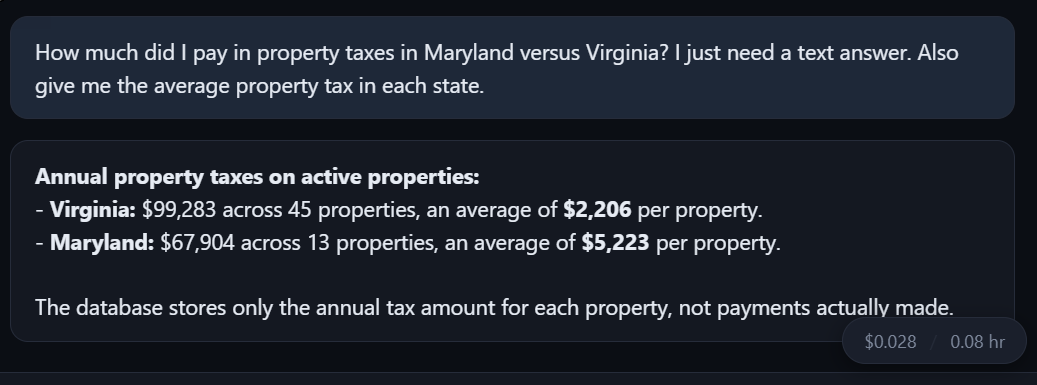
- Answers from any connected system: your accounting software, your own database, the applications built for you.
- Draws a chart when a chart helps.
- Runs the math, so totals and averages are worked out, not guessed.
- Reads photos and PDFs you drop in.
- Hands back a spreadsheet or a report.
- Waits for a person to say yes before any money moves.
Before and after
The same work, without the typing.
By hand today
- Receipts typed in from paper, one at a time.
- Invoices coded by whoever has a spare hour.
- A simple question takes three systems and a spreadsheet.
- Renewal dates live in one person's calendar.
- Reports are built by hand at the end of the month.
With Spine
- Receipts read, checked and logged as they arrive.
- Invoices coded and waiting for one approval.
- Ask once, in plain English, and get the answer.
- Reminders arrive well ahead of every date.
- Reports on request, as a spreadsheet.
Where it runs
On a server in your business's own name.
Your data stays in your own systems. Your accounting software stays the place your books live. If you stop, nothing is held back.
Yours, not ours
The server, the data and the accounts are in your business's name.
Roles decide
Each person sees and does only what their role allows.
What Spine is not
Clear about what it is not.
Not a replacement
Not a replacement for QuickBooks or any product you already pay for. It works with them.
Not a general chatbot
Not a chatbot loose on the open internet. It works on your business and the systems you connect.
Not priced by the seat
Everyone in the business can use it. Roles decide what each person can do.
Start with a fifteen-minute conversation.
In chat, with no login and no sales call. A written brief follows within two business days.
Start the conversationFree. No obligation on either side.